Dag Hammarskjold

I grew up in a family of contrarians, but we all loved collecting stamps. My father had enjoyed collecting stamps with his own father and he eventually won us all over – including Mom – to the hobby. We were part of a mid-century swell of interest in stamp collecting, a hobby that hadn’t really existed until the advent of national postal services in the late 1800s and that has been radically compromised by the 21st century development of custom stamps that come with pre-moistened glue attached to waxed paper. Like hula hoops, pogo sticks, and Mad magazine, stamp collecting is a mid-century fad that lost its mojo many years ago.
There were at least three things that I loved about stamp collecting. The most obvious is simply the collecting-ness of it, the idea that by a gradual system of purchases and finds you could assemble a complete or nearly-complete set of something was very attractive. There are many other manifestations of that instinct, from insects to coins to baseball cards, but it was stamps that made us want to amass, display, and collect. Stamp collecting could be very expensive if you took it seriously, as the rarest and oldest U.S. stamps were well out of my price range then or now. But you could make real progress towards filling out your stamp album for a pittance, often by just buying variety packs of 1,000 used stamps from one of the mail order catalogs. The collecting process in our family was at once collaborative – as we passed stamps back and forth and sorted through bags of mixed stamps – and competitive – as I kept an eye on my little sister’s Mexican album to see whether it was better than my Colombian one. Yet the intra-family competition was tamped down by the fact that, by collecting stamps from different countries, we were each running our own race.
The second great thing about collecting stamps is its tactile nature. Almost all stamps extant in the 1970s were made with a backside that was sticky only when moistened. That meant that, unlike modern stamps, you could get packages full of used stamps that could mingle with one another without accreting into a gluey blob. That in turn meant that large packages of stamps had to be manually sorted – by country, by year, and perhaps by type (e.g “Air Mail” vs. “Special Delivery”) - before they could be placed into stamp albums. Those albums were themselves works of art, from the plebian albums produced by the Minkus or Scott stamp companies to the elegant White Ace stamp albums that were printed on heavy paper and that had artful facts about each stamp. Stamps were then inserted into their respective spots in each album with the use of a paper “hinge” – essentially itself a glued and folded piece of paper – or by “Crystal Mount,” a set of cellophane sleeves that would be trimmed to fit after the stamp had been slid inside. It was all a delicious craft exercise and there was nothing more satisfying than paging through my album and looking at the previous white spaces newly filled with mint stamps inside their snugly-tailored crystal mount sleeves.
My father was quite astute in how he managed his kids’ intrinsic competitiveness around collecting, and his strategy was to set us off on different collecting journeys, typically tied to one or more countries. I settled into collecting stamps from Colombia, China, and the U.S., my older sister Mary collected stamps Greece and American plate blocks, and my little sister Emily collected stamps from Mexico. There was always a hint of history behind these choices, from our time in both Colombia and Mexico of from the used stamps Dad received from his Greek secretary. My brother collected stamps from the United Kingdom and, more broadly, from the British commonwealth, and much later his UK collection served him well as he pondered how to respond to a British party guest’s claim that the United States was uniquely arrogant. “What is the world’s only country,” he asked, “that doesn’t print its name on its stamps?” His Brit visitor had to concede the point.

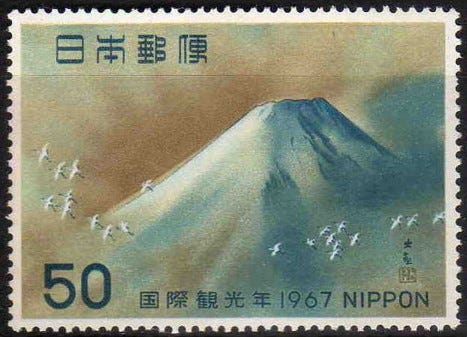
Another great thing about stamp collecting is that you learned things about a country by who or what ends up on its stamps. We all agreed that Japan made the most beautiful stamps, although for a time I thought that Taiwan was a close second. Japanese stamps tended to have muted, tasteful paintings of natural scenes like Mt. Fuji, and, at least in their post-WWII phase, tended to have little to say about politics or history. My mom’s Japanese collection was further adorned with a subset of stamps from the Ryukyu Islands, a Japanese-controlled island chain that includes Okinawa and that for a time put out its own stamps. The fact that countries continued to put out new stamps every year – 40-50 in the United States, for example – meant that one’s collection challenge could never be over. The Ryukyu Islands were a closed set, however, and therefore potentially completed, even if the last few stamps missing from my Mom’s Ryukyu collection were beyond her price range.
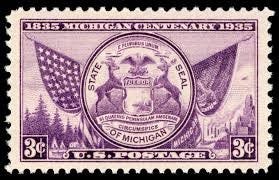
You also learned something about how a country’s interest – or at least that of its government – varied over time, and to me it was America that was the most interesting of all. Early US stamps tended to be boring and unattractive silhouettes of US presidents like John Adams or George Washington, but I very much liked the stamps of the 1930s, with their pretty pinks, light greens, and blues and their celebrations of the anniversaries of various states and national parks. They had a quiet palette that, on stamps at least, I much preferred to the less-restrained look of the 1970s. The stamp below celebrates the 1935 centennial of Michigan’s statehood and, even if it’s mock heroic, I’m proud to say that I had a mint version of this stamp when the sesquicentennial came around 50 years later. I still think it’s beautiful.
American stamps also provided an insight on how stampmakers of the past thought about events that are now viewed differently – or that are at least more contested. In the 1930s, for example, there were stamps celebrating the landing of Columbus; the settlement and development of the Oregon Territory; the centennial of the founding of the Kansas Territory; and the 350th anniversary of the founding of Jamestown, England’s first permanent colony in North America. The five “civilized tribes” of Oklahoma got their own stamp in 1948. These were all events that were at the time viewed with unreserved approval while, in today’s histories, these events are all at least partly interpreted through the lens of native American communities that had adverse or at least mixed responses to these events.
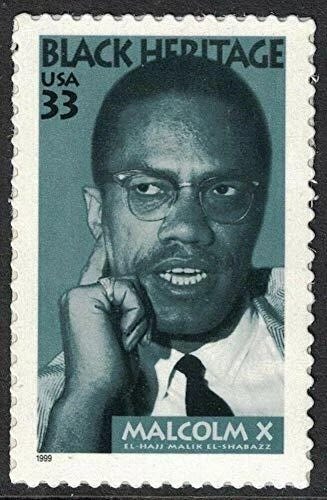
The evolution of stamps devoted to African Americans has its own historiography. The first African American on a U.S. stamp was Booker T. Washington in 1940 and again in 1948, and George Washington Carver was the second in 1948 (with Washington) and again in 1954. Washington and Carver were both very comfortable to white segregationists, accomplished blacks who did not aggressively contest the Jim Crow laws of their day. The rate at which African Americans were depicted in my stamp album began to change with the stamps of the late 1960s – including images of Frederick Douglass (1967), W.E.B. Du Bois (1973), poet Paul Dunbar (1974), and Martin Luther King (1979). The rate increased even more in the 1980s, with stamps depicting Scott Joplin (1983), Sojourner Truth (1986), and Duke Ellington (1986). Each stamp was interesting in its own right, but the frequency with which minorities and women were depicted – and their political valence – told its own story of how the U.S. thought about itself at the time. By 1999, the USPS was even putting out Malcolm X stamps.
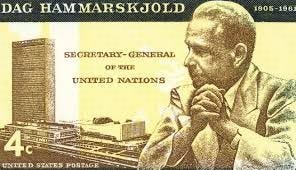
If you could learn a lot of history from stamps, you could also learn a bit of economics. Dag Hammarskjold was a Swedish economist who served as Secretary-General of the United Nations until he died in a 1961 plane crash in the Congo. There is debate as to Hammarskjold’s time in the Congo, where he is alternately viewed as having subverted the democratic process and as having been assassinated by the KGB. Both could be true, of course. Yet there is no debate that Hammerskjold was quickly commemorated by a stamp issued by the U.S. Postal Service, or that a New Jersey collector soon owned a sheet of the stamps that had the background colors inverted. Given the time’s broad interest in rate stamp collection, this was prospectively both a printing error and a serious windfall for the New Jersey collector. In recognition of the fact that such a windfall might produce additional “printing errors” by its own printers, the USPS quickly produced an additional 4 million Dag Hammarskjold stamp with the same inverted background, thereby reducing the worth of the original mistakes to their face value. Some saw this as unfair treatment of the original collector, but others – including myself to this day – see it as an action necessary to reduce the incentives for “errors” in the printing of stamps or currencies. In either case, the two versions of the Dag Hammarkjold stamp sat side-by-side in my American stamp album.
The Ann Arbor Stamp and Coin store opened up across from Arborland in 1979, but there was no stamp store in town when I lived there as a kid. This meant that we could only buy stamps via mail order catalogs from companies like Martin Band of New York City. This was no problem, however, and a couple of times a year, almost always after Dad gave me $10 or $20 on Christmas or my birthday, I would place an order with Martin Band and, a few weeks later, get back an envelope with 30-40 US stamps that I would spend a pleasurable afternoon slotting into the right spots of my Scott stamp album. I only patronized one stamp store as a kid, and that was during the 1972-73 school year when my family lived in Manhattan. We lived on 101st Street and Riverside Drive and my school was on 112th Street, but on occasional Saturdays Dad would take us to the Oriental Stamp Company near Lincoln Center. The store was deep and narrow and it had a glass counter running lengthwise with glass-fronted cabinets running along one of the side walls, all of which were stuffed with albums and books of stamps. I do not remember the proprietor’s name, but he had named his shop after his father’s stamp store in Cairo. He was a jovial presence, but it was clear that he took stamps very seriously.
I fleshed out my US collection during our visits there, a few dollars a time, and I also added to my Colombian collection. It was another example of Dad’s astute attempt to get his children a little engaged in the hyperkinetic travel that he imposed on us and that we might otherwise -and in some instances did – resent for how it took us out our comfort zones. I learned a bit of Colombian history from the exercise, much of which I’ve forgotten, but I think I mostly learned that Colombia – and by extension any other country – had a rich and varied history of its own. Some of that history was heroic, some was boring, and some was quite regrettable, but it was Colombia’s history rather than our own, and the fact that they generally chose to adorn their stamps with historical figures of whom I knew nothing suggested to me that their waters ran as deep as our own. Take a bow, Camilo Torres.
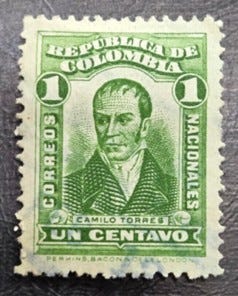
It was in New York City that I started collecting Chinese stamps. I forget precisely why this connection happened, but I think it was likely that the Oriental Stamp Company was selling cheap versions of both a Chinese stamp album and a starter kit of used Chinese stamps. I was bored that year in New York, cooped up in our apartment with only so many Hardy Boys books to read, and so my dad thought I needed another distraction. It worked, too, as I gleefully populated my new album with stamps from the polities that we might know today as Republican China (1912-1949) and then the concurrent reigns of Communist China and the Kuomintang regime of Taiwan. The communist stamps were terrible – both ugly and on thin paper – but China otherwise put out beautiful stamps and I was happy to collect them. And here, too, I learned a little Chinese history – about how Taiwan had been the Japanese colony of Formosa for 60 years and about Chinese politicians like Sun Yat-Sen, Mao Tse-Tung, and Chiang Kai-Shek. Chiang was of special interest because my mom’s family, in keeping with America’s WWII fascination with China, had owned two dogs named Kai and Shek. It made me miss our one-eyed beagle Lucy, back in Ann Arbor, all the more.
I enticed my own offspring into sharing some of my own interests, things like books and basketball, but I never got any of them hooked on stamp collecting. Part of it’s my fault, as I didn’t try hard enough or creatively enough, but it’s also that stamp collecting simply isn’t as cool as it was back in the 1960s and 1970s. There are a variety of theories as to why that might have happened. First, stamps are simply less important in everyday life than they used to be. Most bills are delivered and paid electronically, far more media is distributed via other forms, and even packages are less likely to be delivered by the Postal Service than by competitors like FedEx and UPS that barely existed back then. A second reason is that the competition for attention is so much tougher today, with video games, social media, and streaming video all hogging the attention, especially that of young people who might get hooked on a lifelong habit. And as one final conjecture, it’s possible that the vicarious tourism of 1970s stamp collecting – the insight you got from pawing through a 1,000 cheap, used stamps from 80 different countries – is more readily filled by the internet and cable television. You could learn a bit about, Bolivia, for example, by buying some of their old stamps, but there are probably cheaper and more efficient modes of collecting that information today.
Whatever its underlying cause, there’s no denying that the stamp collecting business is a sleepy shell of its former self. I learned as much a few years ago when I took all of my old albums – from the US, from China, and from Colombia – to a local stamp store to sell. This was partly a desire to declutter, partly a recognition that my offspring had little interest, and lastly a belief that perhaps, somewhere in Montgomery County, there might be a few young people who would like to advance my collection, to bring it up to date, and that by keeping it in my hands I was somehow misallocating a resource, keeping it in the hands of someone who no longer gave it the love it deserved when, out there, there was someone who would adopt them like a new puppy. I was quickly disabused of this last notion when I entered the sleepy stamp store a few blocks from my house, and the proprietor, about my age, seemed almost surprised by the arrival of any patron. He did in fact pay me a few hundred dollars for my Colombian and Chinese stamps, as he knew some local collectors to whom he might resell them at a profit, and I was glad to hear that at least those stamps would find a new home. Yet he wouldn’t take my US collection at all, as he said it was worthless.
“But what about the 1924 airmail biplane stamp?” I asked plaintively.
“Not worth my time,” he said.
“But what abut the 1935 Michigan centennial stamp? It’s in mint condition!”
“Worthless,” he said.
“And what,” I asked with extra whininess, ”about the Dag Hammarskjolds? I’ve got both of them!”
“Less than worthless,” he said firmly.
And so he handed me back my US stamp album, bursting with stamps attached to album paper that was now 50-60 years old, many of them in mint condition and beautifully mounted in crystal mount, and he gave me directions about how I might send it off to a charity that provided stamps to disabled veterans who might find some entertainment from the stamps. And that’s what I did.
Well, with regard to money, the old adage is true: "Philately will get you nowhere". Yet, for you and many others it provided hours of fun, bonding, and friendly competition with your family, helped you explore world history and culture, and provided an awesome topic to write about. My family also dabbled in the hobby, my parents mostly, and I fondly remember them soaking used stamps - both in water to remove the bit of envelop still attached, and then in lighter fluid, I think to remove residual glue (or some combination of that). Dad had plenty of that around due to his ever present Zippo to light up his Kent cigarettes, until he quick cold turkey and chewed gum like a fiend for what seemed like a year to assist with kicking the habit. They had the big binders and focused on US stamps exclusively. I had an old international book and got US castoffs to add and the occasional international stamp from my world-corresponding paternal grandparents.
Great piece as usual, Will!
My husband and I both have multiple albums from the 1950s filled with stamps from hundreds of countries. Not sure what to do with them now. Seems a shame to put them in the recycle bin.