Decolonizing Bethesda

My psychiatrist and I visited the Jerusalem Café in Berkeley during a visit to our daughter this past August. The café had wonderful espresso and, for completely unnecessary reasons, the kind owner converted them both into affogatos. They were delicious, but then I generally respond well to free ice cream.
We chatted for a while and found that he was a Palestinian-American whose family had roots in Jerusalem. He had opened the café in the first week of October 2023, within days of the Hamas attack that started the ongoing war in Gaza. We gave him a look that he had obviously received before. “We didn’t plan it that way,” he said. The three women at the next table wore headscarves and had Frantz Fanon’s The Wretched of the Earth at the top of their stacks of books.
Fanon has been an icon for decades, sort of the Che Guevara of anti-colonialism, but the war in Gaza has elevated his profile even further. Pro-Gaza protesters carry Fanon’s books, use his picture on their social media profiles, and see in Fanon a roadmap for Gazan protest. Counter-protesters argue that the current strife does not fit a colonial model and that, even if it did, Hamas has misinterpreted Fanon’s views on violence. For better or worse, Frantz Fanon is having a moment.
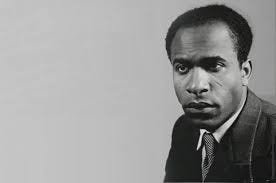
Fanon was born in 1925 in Martinique, a Caribbean island that was then a colony and is now part of France. Almost all Martinicans had at least some African heritage, a legacy of the French slave trade that brought hundreds of thousands of Africans to work on Caribbean sugar plantations. As Fanon documented in his first book – Black Skins, White Masks – this led to a society in which those with lighter skin, who were perceived as more French, had the upper hand. Fanon was only 26 years old when the book was published in France and attracted fans like Jean-Paul Sartre.
Fanon was a rebel from the start, first against his own father, and then against the Nazi-sympathizing Petainists who ruled Martinique in his youth. He fled Martinique to join the Free French forces in 1945, one of thousands of French colonials who joined the fight against the Nazis. Martinicans thought of themselves as the favored children of France, far more sophisticated than France’s colonial subjects in Africa. If you had asked 19-year-old Fanon whether he was more French or African, he would have undoubtedly answered “French.”
That love of the distant metropole was perhaps why Fanon was so hurt by how French people reacted to him during and after the war. French soldiers were contemptuous of the Martinicans, seeing them as no better than the North Africans. Post-war Metro riders clutched their children when Fanon sat next to them and some patients refused to let him examine them when he was a medical student in Lyon. Was that any way to teach a genuine Frenchman who was smarter, more ambitious, and more accomplished than they would ever be? Fanon didn’t think so.
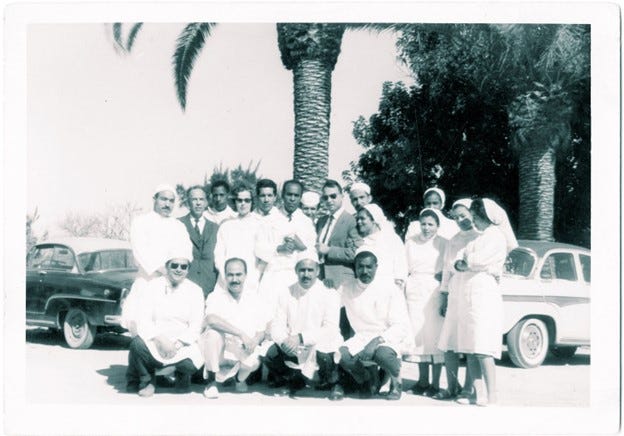
Fanon moved to work at a psychiatric hospital outside of Algiers in 1954. This was the year in which the Algerian independence movement began and in which, not coincidentally, the French army lost to the Vietnamese at Dien Ben Phu. The world wars had eroded colonizers’ claims to cultural superiority and the collaboration of many French with the Nazis had done particular damage to the logic of French colonialism. Algerians sounded a call for independence that was heard throughout Africa….and by Fanon himself.
Fanon treated psychiatric patients from both sides of the war. He heard the laments of French enlistees who had seen their fellow soldiers shot or blown up and who had in turn shot and tortured Algerians. He also heard Arab Algerians who, in Fanon’s diagnosis, suffered from the psychological effects of colonialism. Put roughly, colonial subjects had imbibed the message of European superiority that colonialists had used to justify violence and repression. Fanon thought that it was necessary, as a matter of both politics and mental health, to “decolonize the mind” by rejecting European culture and claims to superiority.
Decolonization movements always mix violence and persuasion, like the colonizers themselves, but the mix varied considerably across countries. Mohandas Gandhi was a proponent of non-violent revolt and, in India it worked. Fanon saw things differently. Fanon thought it better to violently drive off the colonizers, perhaps even to kill them, because only through that process could the colonized free their minds of the oppressive belief that they deserved to be colonized. True freedom needed to be taken, not bestowed.
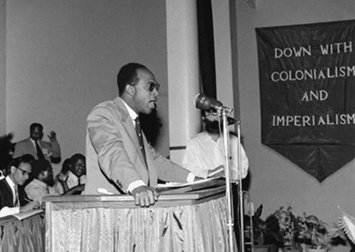
Fanon supported the Algerian rebels for three years before being exiled to Tunisia when the French learned of his actions. He worked as a roving ambassador for the Algerian rebels, ultimately serving as their ambassador to Ghana. Fanon was probably never much practical use as a rebel, as he never learned Arabic and, outside of his clinic, he only hobnobbed with intellectuals of the Algerian resistance, but his intellectual legacy has turned out to be quite durable.
Fanon’s ongoing reputation lies partly in the romance attached to any foreigner who embraces a liberation struggle – Lafayette, Che Guevara, and Lord Byron also come to mind. Yet Fanon’s fame mainly comes from the continued relevance of his last book – The Wretched of the Earth – published in 1961 and still showing up in student backpacks at the Jerusalem Café. He was still only 35 years old when it was published, but it turned out to be the last thing he ever wrote.
It’s a bit ironic that Fanon’s analysis can be used to retroactively understand some aspects of early American culture. Europeans of the 18th and 19th centuries tended to think that America was inferior, even to the extent that American animals were viewed as weak and enervated versions of their European cousins. It all irritated Thomas Jefferson so much that he had a stuffed bull moose shipped to Paris.
Mark Twain later mocked Americans’ over-reverence for European sophistication.
What is there in Rome for us? We have gone there and seen with our own eyes that the most glorious creation in the earth is a blank ruin, and we do not care to dream over it anymore.
and
What a robust people they must have been to build such majestic piles of stone, and what a robust piety they must have had to worship in them.
Fanon wasn’t funny, but he and Twain both pricked colonized people’s sense of inferiority.
It’s only fair to view Fanon’s work through an Oedipal lens. France often represented itself as a firm but just patriarch that guided its colonies toward modernity and progress. France also positioned itself as a “mother” who bestowed gifts of education, infrastructure, and healthcare, and French colonial schools fostered loyalty to the "motherland." Fanon adored his own mother, but some of his views were surely affected by his distaste for his own father. If France was his father, he wanted none of it.
Fanon criticized newly liberated colonies’ bourgeoisie for replicating colonial hierarchies. What good was it, Fanon wondered, if the French were merely replaced by a new, more localized father figure? No, Fanon said, the formerly colonized needed to find a new, non-European mode of living together – “we have better things to do than follow in Europe’s footsteps.”
I don’t think that Fanon ever articulated a credible guide for what that non-European identity would look like. His last words on the topic were as follows:
For Europe, for ourselves and for humanity, comrades, we must make a new start, develop a new way of thinking, and endeavor to create a new man.
This rhetoric still plays in some quarters, but to my ear it sounds like the scribbling of a naïve young man…but then he was barely 36 when he wrote that.
Fanon’s oeuvre has worn less well from a Western feminist perspective. French authorities had for several decades tried to win over Algerian women by helping them in what were, from the French perspective, their struggles with Algerian men. French employers would invite wives to corporate parties, and French functionaries would encourage women to give up their veils. Algerian men viewed this as a violation, as if the authorities were asking them to pimp their own wives, and some Algerian women preferred the old ways, too.
Fanon derided France’s efforts to unveil Algerian women as a cynical effort to divide and conquer, yet another means to convince the colonized that their culture was unworthy.
Every veil that fell… was a negative expression of the fact that Algeria was beginning to deny herself and was accepting the rape of the colonizer.
I wish that I had asked those smart, veiled young women in the Jerusalem Café about what they thought of these words.
Western liberals still struggle with some of those same tensions. Liberals are very attached to the Fanonian idea that the traditions and beliefs of other cultures are entitled to respect and even deference. Yet something has to give when those beliefs are at odds with those of western liberals.
In Bethesda, these struggles have surfaced in the selection or elimination of books from school curriculums. A Maryland court recently ruled that parents cannot opt out of school curriculums that conflict with their religious views. As one news source wrote:
The ruling was a shock to parents, the majority of them Muslim and Ethiopian Christians, who (objected) to new requirements that their children….would be mandated to read … books about LGBT topics, regardless of their parents’ objections. “It’s very disrespectful,” said Shaykh El Hadji Sall. “It’s ignoring the will of the people.”
I’m not sure what Fanon would have thought of this.
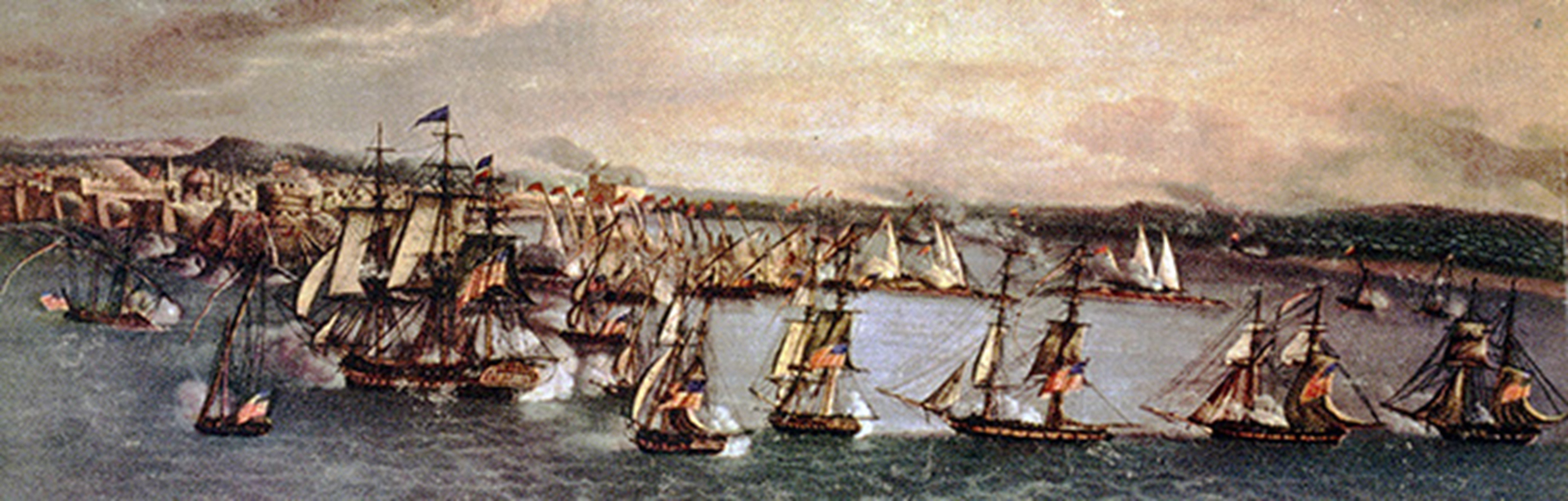
There are other ironies in Fanon’s relationship to the United States. One is that American nationhood was partially forged by war with Fanon’s adopted home of Algeria. “Barbary” ports like Algiers and Tripoli terrorized European shipping and coastal towns for centuries, carrying off hundreds of thousands of people to ransom or sell into slavery. Ships of the young United States were at particular risk to these pirates as they no longer had any protection from the British navy.
The Barbary pirates’ predations spurred America to build a standing navy and army, and in 1815, the navy obtained a treaty with Algiers that banned future capture of American ships. In a very Fanonian way, it was the violent throwing off of the Barbary yoke that built American nationhood. That fact is commemorated in the Marines’ Hymn: “From the Halls of Montezuma, To the Shores of Tripoli, We fight our country's battles, In the air, on land and sea.” The reference would have been to Algiers if only it had a better rhyme.
Another irony is that Fanon died in Bethesda, the DC suburb where I have lived for thirty years. Bethesda is full of lawyers, economists, and physicians and its residents tend to work for the federal government in one way or another. If a revolution ever descends on Washington, DC, the heads of many Bethesdans will be on pikes around the capitol. Yet this is where Fanon died.
Fanon developed leukemia in 1960 and, as a physician, he was quite aware that his sickness was very serious. Algerian friends convinced him to travel to the US for treatment at the National Institutes of Health, located in Bethesda then and how. Yet it was a hopeless case. Fanon died in late 1961, six weeks after he had arrived in the United States. His body was flown back to Tunis and then driven over the border to Algeria – in the last months of its war with France – to be buried in a cemetery of martyrs. Algeria gained its independence in March 1962, three months after Fanon’s death.
Fanon never engaged with Martinique’s independence movement, and it is now an overseas department of France, rather like a French Hawaii. One impediment to independence is the country’s continued reliance on economic help from France. Still, the anti-colonial instinct lives on in Martinique’s adoption of a version of the pan-African flag that it often flies alongside the French flag. It wouldn’t satisfy Fanon, but perhaps it’s a start.

That was a riveting read! I wonder what Fannon would have made of his enduring relevance to the times we have lived through?