Mid-Century Moderns

My parents were pretty frugal – we never ate out, Mom cut our hair, and we had ratty cars while we lived in Ann Arbor. All cars stunk back then, at least by modern standards of reliability, construction, and amenities, but our cars were extra ratty – two used Ford Pintos for my older siblings, a 10-year-old mid-sized Buick for Dad, a rattly-from-the-start Dodge Dart for Mom, and a Delta 88 from my grandmother that my cousin Jimmy used while he lived with us. I would soon learn to drive one of the Pintos and, among my challenges was a gluey clutch and a loose stick-shift knob that fell under the accelerator. My parents bought some nicer vehicles later, when they had more money, but my dad owned his last car for 17 years. I essentially stole it from him when he became too infirm to drive and I promptly donated it to The Humane Society. I took a $10 tax deduction and that was stretching it.
Yet there were a few things that my parents did splurge on vis-à-vis their resources. First, while we all went to public school in Ann Arbor, they had no compunction about putting us in private schools in New York or Bogota if that facilitated Dad’s professional tourism. Second, they occasionally plumped for trips to Europe with one or two of their children while the remaining kids stayed behind with a niece or law student. The European trips were low-budget – the cheap charter flights had to refuel in Goose Bay, Canada – but the mere fact that we went was a luxury. Yet the most prominent splurge of our childhood was 3098 Newcastle Road – a 2,500 square foot home with five bedrooms and a woodsy yard. My parents weren’t sure they could afford the mortgage payments, but they liked eccentricity and risk and buying an aluminum house from Ann Arbor celebrity Zeke Jabbour gave them both.
Mom later described their dealings with Jabbour in 1965 as they shopped for a house in Ann Arbor.
What made the construction cost-effective was its design. Workers first put together the black steel I-beams to form the exterior frame. They then bolted the 12’x8’ panels of aluminum …or insulated glass panels into the I-beams. The house was done in less than a week. The exterior looked like a Mondrian painting, with panels of red, blue, yellow, and white. Some critics thought it looked like a bank.
Other critics thought it looked like an LSD trip. Whatever the critics thought of it, I loved our house on Newcastle Road. Perhaps that was why, right from the start of kindergarten, I became best friends with a boy who also lived in a Zeke Jabbour house.
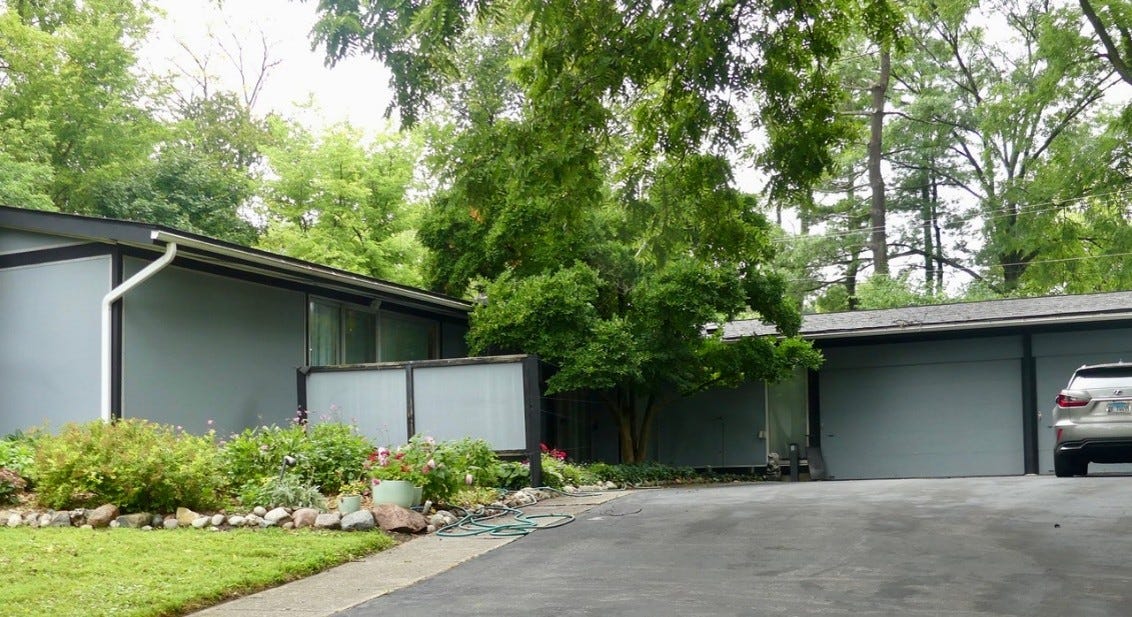
One of the most dramatic events of my childhood happened right behind the garage door pictured above. My friend’s 16-year-old brother was preparing to drive a few of us off to play tennis when he mistakenly slipped the transmission into “drive” rather than “reverse.” The car of course lurched forward into the back wall of the garage, the kind of error that your correspondent would himself soon be making when he became a 16-year-old driver. Most collisions between cars and houses turn out badly for the car, but in this instance it was the 12’x’12’ back panel of the garage that flopped quietly onto the back lawn. The sudden removal of the back side of the house was very disconcerting, but it was a direct consequence of the modular construction and it was ultimately quite easy to repair. Our own house suffered a similar insult when a huge oak tree keeled over in a storm. The tree removal people said that they would normally pull such a tree out of the basement, often only after the EMTs had removed some bodies, but our house was merely bent. The bottom of the oak leaned against the house, a large section of trunk lay across the flat roof, and 50-60 feet of the top was in the backyard. After the tree was gone, Zeke’s men merely bolted in a new I-bar and panel, and after 30 minutes the house was good as new.
Zeke Jabbour was born in 1928 in Youngstown, Ohio, part of a community of Lebanese Christians who had left the Ottoman Empire in the late 19th century and tended to run confectionaries and small grocery stores. Zeke himself graduated from Youngstown State and, after serving in Germany in the post-WWII U.S. Army, moved to Ann Arbor in the early 1950s to study Middle Eastern affairs at the University of Michigan. Zeke’s energy and intelligence quickly made him one of Ann Arbor’s leading citizens as he became, in short order, a real estate developer, a theater impresario, and a newspaper columnist for the Ann Arbor News. I only met him when he came by to advise my parents how to care for an aluminum house, but he always made an impression.
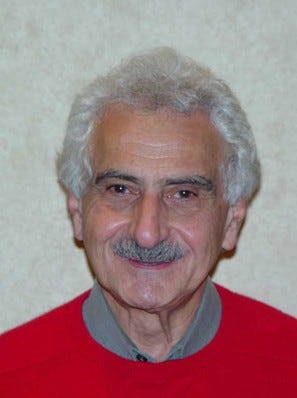
Zeke’s real estate company designed and built modern houses all over Ann Arbor – many of which survive today and are still marketed as “designed and built by Zeke Jabbour.” There is now an organization devoted to Ann Arbor’s mid-century modern architecture and they have a full page devoted to Zeke Jabbour and the houses he built. There were many architects – which Zeke was not – working in Ann Arbor and in other Michigan towns like Kalamazoo and Midland, and so Zeke was very much part of an artistic and architectural movement. Yet Zeke’s aluminum houses – including 3098 Newcastle – were of a style that, while it obviously appealed to my parents, was on the fringe of good taste. As my mother noted above, our house really was a Mondrian knockoff, with exterior walls an alternating set of panels in bright reds, yellows, and blues. The houses still exist, but they’ve now got peaked roofs and earth tones.
Zeke was all over the Ann Arbor News, the town’s main newspaper, in society notes, in theater reviews, and on the News’ coverage of the junior sports team that Zeke sponsored Zeke also advertised for his homebuilding business and the ads were at once funny and whimsical. To wit, when was the last time you saw a homebuilder make a sales pitch in verse:
If the details there are clean and unpretentious
And the treatments used, as right as one could ask;
If this and more is true when you’re residing,
And your housing needs are well provided for;
Then you don’t need (a fact not worth hiding) –
Or perhaps you’ve found a home built by Jabbour?
It didn’t win any poetry prizes, but I like the hustle and ambition.
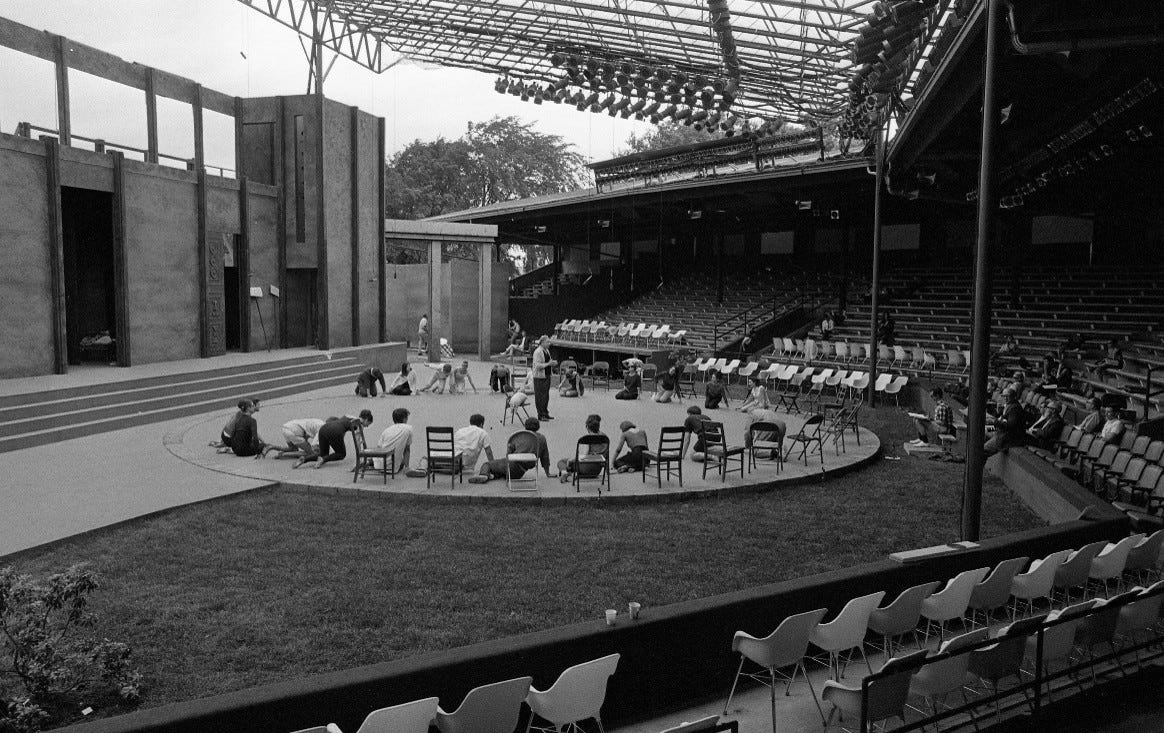
Zeke hustled on many other dimensions as well. He was very active in the local theater scene, both acting and helping to develop the Greek Theater in the neighboring town of Ypsilanti, named after a general from the Greek war of independence. The Greek Theater only operated from 1963-67, but it attracted big-name actors like Ruby Dee and Bert Lahr and its productions were reviewed in the New York Times. Jabbour both acted in and produced some of the productions, and it was his construction company that created the outdoor theater out of a repurposed baseball stadium.
Zeke also sponsored youth travel teams in both baseball and hockey; he sponsored and trained a contestant for the Miss Michigan contest; and he was profiled in a 1964 Ann Arbor News article about “bachelor chefs” in which he disclosed that he learned all his tricks from his Lebanese mother. For these and many other reasons, a 1978 letter to the Ann Arbor News complained that the paper had shortchanged Zeke by referring to him as a “local contractor.” It would be more appropriate, the letter said, to refer to him as a “Renaissance Man.”
It would also be hard to overstate the breadth of issues covered by Zeke’s columns in the Ann Arbor News, and his were often the same issues that I cared about as a boy. He wrote in favor of handgun control, and by the age of 14 I was also a dues-paying member of a society devoted to a handgun ban. He wrote extensively about public aesthetics, particularly about gardens in parks and public housing projects at a time when, while at camp, I was picking up litter by the sides of northern Michigan roads. Zeke also wrote about amnesty for Vietnam draft dodgers, about democracy in Greece, and about whether or not the Watergate burglars should be exiled.
The Ann Arbor News also reported that Zeke rescued the 1973 wedding of a Toledo couple caught in an Ann Arbor snowstorm. Jabbour somehow “learned of the family’s disappointment and promised them a wedding”, persuaded a judge “to drive through the heavy snow to perform a civil ceremony, “hurried home to bring back a cake he had,” and inveigled a photographer to “travel by foot, by car, and finally by snowmobile to take wedding portraits.” Even more than the snow, Zeke Jabbour was a force of nature.
All this energy was an aside to the career – bridge – that later made Jabbour famous. He was a talented player from a young age, but he later began to play high-level competitive bridge playing in tournaments in many countries and even on cruise ships. He also wrote a column that was syndicated in many newspapers, including the Detroit Free Press, the Miami Herald, and the Palm Beach Post. (Omar Sharif - born four years after Jabbour and also the son of Maronite Christians - also wrote a syndicated bridge column.). Zeke was inducted into the American Bridge Hall of Fame in 2017, twenty years after the onset of Parkinson’s disease, and the Hall cited how Zeke “has maintained his sense of humor and amiable disposition despite the health challenges.” His wife noted that “he’s still as sweet and kind as ever” and that while ne now plays slowly “he will not allow himself to play a wrong card.” Jabbour moved from Ann Arbor to Palm Beach in the 1980s and died there in 2023 at the age of 94. He appears to have only married once, late in life, despite his excellent Lebanese cooking.
Dad also played cards during our years in Zeke’s house, though his game was poker rather than bridge. Dad played in two separate games that each met once a month for about a decade – known respectively as the “big game” and the “little game” for their respective stakes. Dad enjoyed the big game, a table full what passes for alpha males among the professoriate, but he was often intimidated off of good hands by the aggressive bidding of economics professor Peter Steiner. Steiner had recently written a best-selling Economics textbook and, as a result, Dad felt that Steiner had too much money to be a good poker match.
The little game was also full of academics, but they were a more chatty, low-key crowd. Dad came to find the little game boring and wanted to leave but could not find a graceful way of doing so. There were a number of motivations for our ultimate departure from Ann Arbor in 1978 – Dad had a big job at Duke, there were better library opportunities for Mom in the Research Triangle, and they were both restless - but in an unguarded moment Dad said that he was also looking for a graceful way to leave the little game. He never played poker again.
Both Mom and Dad had a laissez-faire attitude towards wild animals in their house. Much later, when they were old and a bit off their mental game, this expressed itself as a toleration for mice in their kitchen, an attitude that drove me nearly insane. Yet in Michigan the intruders were much more likely to be raccoons. Our aluminum house had no fireplace, but Dad had installed a wood stove in the basement, the flue of which curved back before turning up again outside the wall. The stove generated real heat in the chilly downstairs, but the flue stopped drawing one evening and smoke accumulated before we doused the fire. We quickly noticed that a foot-long horizontal portion of the flue was warmer than the rest and deduced that a raccoon resided in the flue. We thought the raccoon needed the space and so the stove was retired for the season.
Another raccoon regularly invaded our kitchen by chewing through a screen door one summer, including one evening when Dad’s big poker game was in session in the adjacent dining room. “What is that?” the other players asked when hearing non-human noises from the kitchen. “Oh,” said Dad, “that’s just a raccoon getting at the crackers.” This was not believed and so, after some discussion, Dad took them into the kitchen to see the culprit, but only after having laid a few side bets that he promptly collected.
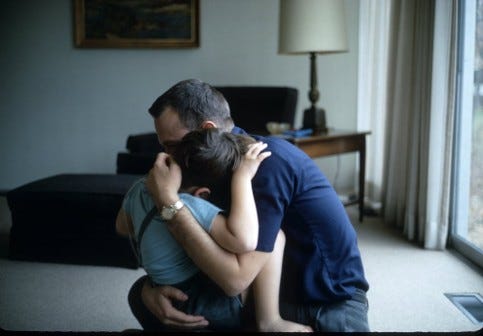
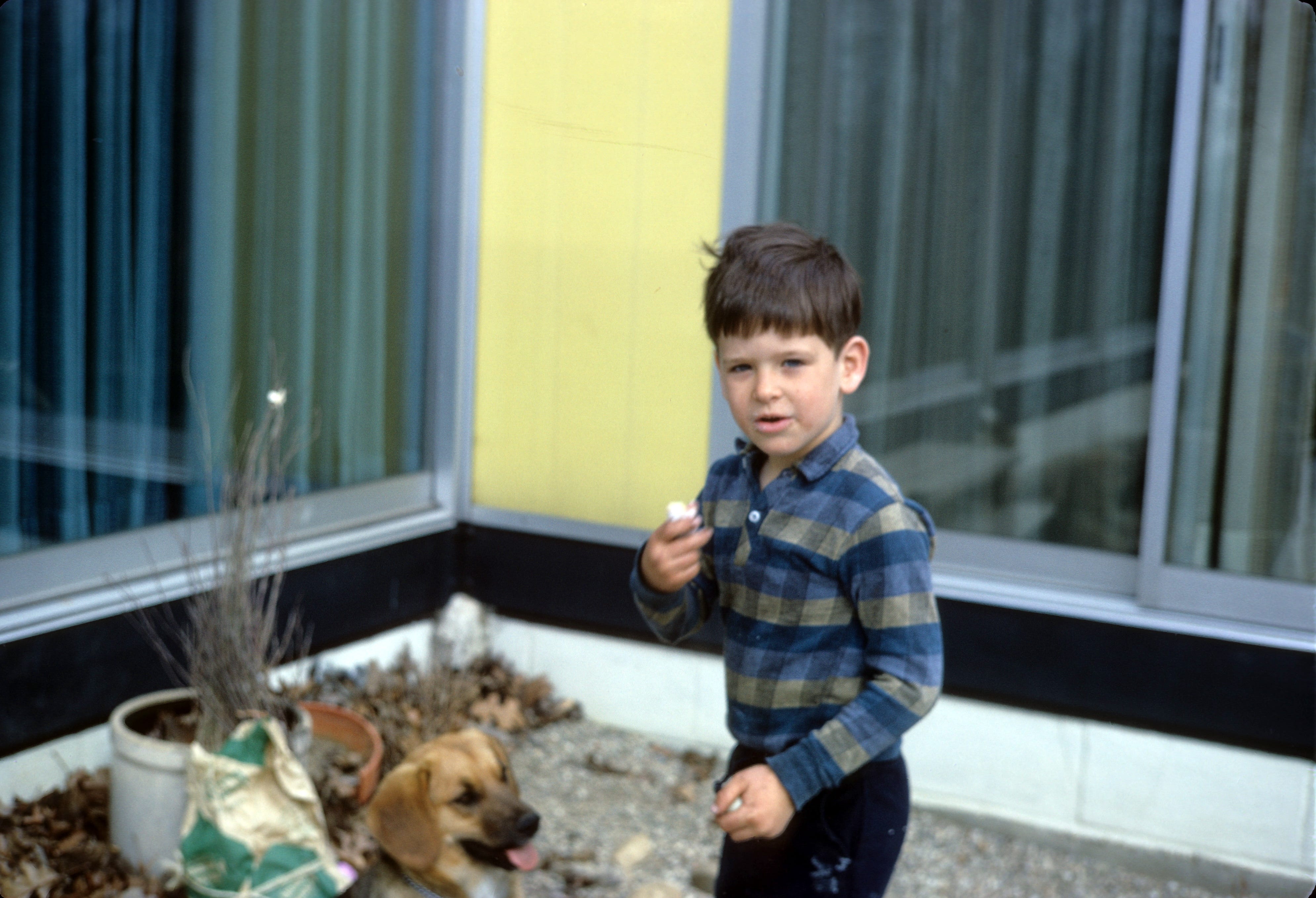
I love the above picture of Dad and me for sentimental reasons. But I also love the picture because it shows the HVAC vents in the floor and the walls that alternated between aluminum and glass, and because it shows some of the older furniture that my parents had inherited – a lamp from one grandmother, a side table from another - and a dark oil painting from one of their aunts. We had a lot of fussy, old furniture like that, and the basement was full of cheap utilitarian furniture – bean bag chairs, bunk beds, and dressers of the sort that you might today buy at Ikea.
Yet my parents also splurged on a few pieces of modern art and furniture that went better with the house. There was an early version of the Arne Jacobsen-designed “egg chair” that is now widely available, a round lucite kitchen table that is a knock off of an Eero Sarinen original, and there was a lucite Victor Vasarely object that stands by my desk today, quite out of place with the rest of my décor. Our house was a weird mix, modern bones stuffed mostly with fussy old or cheap new furniture, but with a few objects that looked like they belonged in the house.
I loved our house on Newcastle Road. Yes, my basement room was dark and isolated, especially after my brother went off to college, and it was a long trek to Mom’s bedside when my pre-K self woke up with a bad dream. But I came to love the windowless walls where I could put up as many maps as I wanted. I even came to appreciate the isolation as a teen, when I could play my brother’s Yes and King Crimson LPs without bothering anyone else in the family. I loved the basketball hoop in the front driveway and how my mom didn’t get too mad when the ball bounced into her succulent garden. I loved the whiffleball field and the “Viking hut” that Dad had built for us in the woods. I loved sledding down the little hill into the Leveque’s yard after a snowstorm, sometimes on a runner sled but more often on a saucer. I loved playing ping pong – and later beer pong – with my brother on the basement table.
It was the house where my family was most my family, when my little sister and I became real people and when my older siblings were still in the house, and it was the last place that the six of us – my parents and us four kids – lived together under a single roof. I have an odd, romantic fascination with Wyoming, where my parents lived with my two older siblings - it’s a version of my family without me. And yet it was on Newcastle Road where my family was most fully and authentically itself, a version that included all of us before time and fate scattered us. It was home.
Lovely writing, as usual. My architectural historian wife wrote her Master’s thesis on Lustron Houses (https://en.wikipedia.org/wiki/Lustron_house) so your description of the house was very interesting. When we moved to a rental house in Kansas City in 2012, there was a Lustron house adjacent to the backyard. Great essay.
It makes me very happy to read this, thanks, i needed that.
First, I love all of the different eccentric and eclectic home decor. It reminds me of our '70s Maine farmhouse. Beanbag chairs. Jodul woodstoves, after we went offline during the energy crisis, which meant that I solit 15 cords of wood every fall and brought it from the scary barn every night, and mostly furniture my dad and I made.
Your house sounds amazing. Mr. Jabbour sounds like a kind of a self-made Frank Lloyd Wright, and all round genius. Actually our house here in India is made out of prefab panels, fiberglass and glass fiber put together in Austrtralia and now here at IiT. 4 or 5 inches thick and 11 feet tall, the crane put them all in place in a few hours. But I wish we had the primary color scheme.
I love this. I love that kind of spirit, you know, just putting things together. And it was kind of a '70s thing in a way, but it also sounds like your family's kind of thing, and ours. We bought everything in secondhand stores or at yard sales, and we made most of our furniture.
Similar story with vehicles. VW bug with hole in floor that snow bounced through. A 40s Ford pickup that had to be started under the hood, then s run inside. And our last American car, a Volare, that broke down and my dad, patriotic but practical, switched to Toyotas and still drives at 95.
What a, what a great, lovely essay. I will read it many more times. Each sentence has a different flavor to it and personality. And there's just a lot of love in your family, for everything, for each other.. it seems like you had infinite care for every aspect of your lives, making them unique and interesting. And I really wish I'd met your folks. And your mom looks just lovely. Your dad too.
Beautiful.